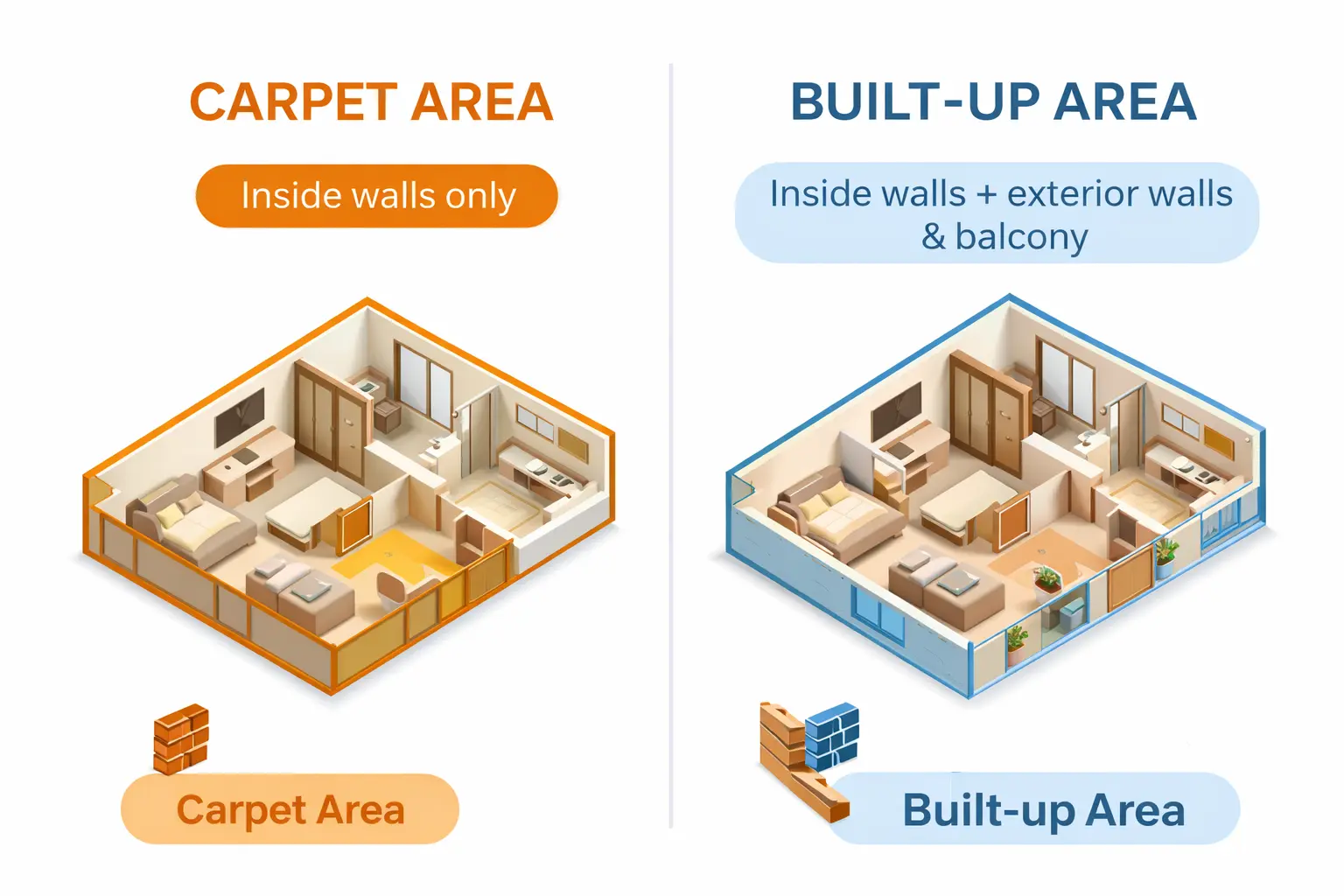
carpet area vs built-up area
Carpet Area vs Built-Up Area: The Ultimate 2026 Guide | Onmarq Table of Contents Carpet Area vs. Built-up Area vs.
Buying a home in India is a dream for millions, but the journey from browsing brochures to receiving the keys is often paved with confusing jargon. One of the most common points of frustration for homebuyers is the “shrinking apartment” phenomenon: you pay for 1,500 sq. ft., but the actual usable space feels significantly smaller.
In the Indian real estate market, “area” isn’t just one number. Understanding the difference between Carpet Area, Built-up Area, and Super Built-up Area is the difference between making a smart investment and overpaying by lakhs of rupees.
The simplest way to understand carpet area is exactly what the name suggests: the area that can be covered by a carpet wall-to-wall. It is the net usable floor area of an apartment.
Living and Dining Rooms: The main areas where you spend your time.
Bedrooms and Guest Rooms: Wall-to-wall usable floor space.
Kitchen and Bathrooms: Essential functional zones.
Internal Passageways: Any corridors inside the flat.
External Walls: The thick outer perimeter of the house.
Service Shafts: Vertical ducts for pipes and wires.
Shared Common Areas: Lobbies, lifts, and stairs.
Balconies and Terraces: Even if they are for your exclusive use, standard carpet area often excludes them (though RERA rules have specific nuances).
Pro Tip: If you want to compare two flats purely on functional space, comparing their carpet areas gives you the most honest metric.
Before the Real Estate (Regulation and Development) Act, 2016 (RERA), builders used various confusing definitions to inflate space. RERA brought much-needed standardization.
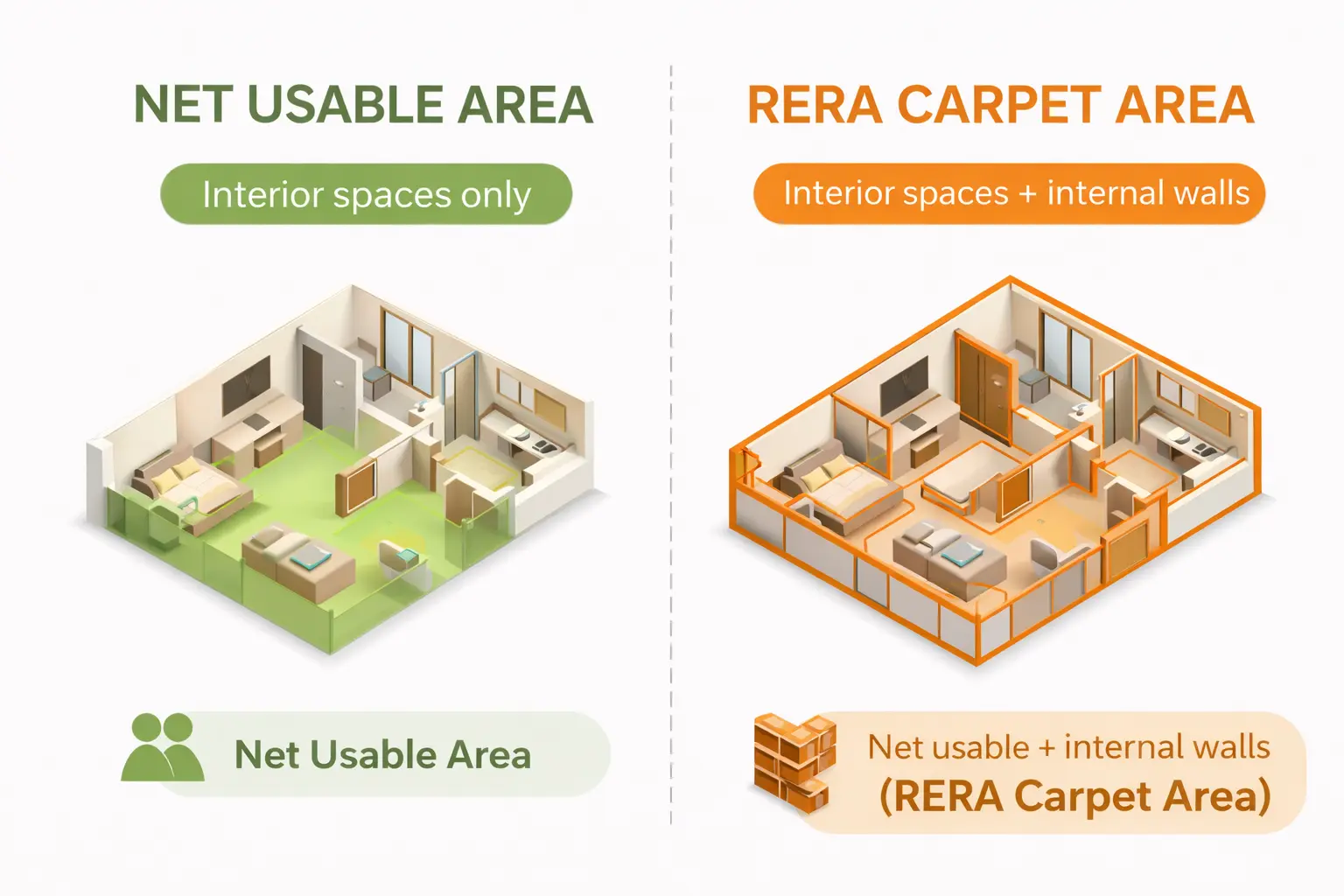
According to the Act, RERA Carpet Area is the net usable floor area of an apartment, excluding external walls, service shafts, exclusive balconies/verandahs, and exclusive open terraces, but including the area covered by internal partition walls.
Mandatory Disclosure: Builders must now sell and quote prices based on RERA carpet area.
Refunds for Discrepancies: If the actual carpet area at the time of possession is less than what was promised, the builder must refund the excess amount to the buyer with interest.
Accuracy: RERA carpet area is typically 5% to 7% higher than the general “old” carpet area because it includes internal wall thickness.
Built-up area (also called the “plinth area”) is the total area that is physically constructed and enclosed within the property.
Formula: Built-up Area = Carpet Area + Thickness of Internal & External Walls + Exclusive Balcony/Terrace.
It provides a more holistic view of the total structure.
It typically exceeds the carpet area by 10% to 20%.
While it encompasses more space, much of this (like the walls) is not “practical” for daily use.
This is the number you see most prominently in marketing brochures and advertisements. It is also known as the “Saleable Area” because it is the figure builders use to calculate the total price of the property.
Formula: Super Built-up Area = Built-up Area + Proportionate Share of Common Areas.
Lobbies and lift shafts.
Staircases and common corridors.
Clubhouses, gymnasiums, and swimming pools.
Gardens, parks, and even refuge areas.
The difference between the carpet area and the super built-up area is called the Loading Factor. Builders use this to recover the cost of constructing common amenities from the buyers.
Standard Loading: In a typical project, the loading factor ranges from 25% to 45%.
Luxury Impact: Luxury apartments with massive clubhouses and large gardens often have a higher loading factor (sometimes reaching 60%).
The Math: If a flat has a 40% loading factor, it means only 60% of the space you paid for is actually inside your home.
| Parameter | Carpet Area | Built-Up Area | Super Built-Up Area |
|---|---|---|---|
|
Simple Definition |
Area you can cover with a carpet |
Total area within apartment walls |
Total saleable area |
|
Includes |
Rooms, kitchen, toilets |
Carpet + walls + balconies |
Built-up + common amenities |
|
Exclusions |
All walls and balconies |
Common areas like lifts/lobby |
None |
|
Size Comparison |
Smallest (70% of built-up) |
Medium (10-20% more than carpet) |
Largest (The number you pay for) |
|
Usage |
Best for interior planning |
Secondary structural comparison |
Property pricing and valuation |
Don’t rely solely on the developer’s claims. Follow these steps to verify the space:
Measure Room Dimensions: Use a tape or laser measure to find the length and width of every room.
Multiply for Area: Multiply length × width for each room and sum them up.
Account for Walls: For RERA carpet area, add the thickness of the internal partition walls.
Calculate Efficiency Ratio: Divide the Carpet Area by the Super Built-up Area. A ratio of 65% to 70% is considered good space efficiency.

Understanding these terms isn’t just academic—it has a direct financial impact:
Price Per Square Foot: Always calculate the price based on the carpet area to see the true value of the home. A project might seem cheaper on a super built-up basis but much more expensive on a carpet area basis if it has high loading.
Property Tax: In many cities, property tax is calculated based on the built-up or carpet area.
Home Loans: Banks usually evaluate the property’s worth and your loan eligibility based on the carpet area.
When you visit a site office at onmarq.in, don’t just ask “What is the price?”. Ask:
“What is the RERA Carpet Area?”
“What is the Loading Factor for this project?”
“Can I see the RERA-registered floor plan?”
By focusing on the carpet area, you ensure that you are paying for space you can actually use—the space you will truly call home.
No, under RERA (Real Estate Regulatory Authority) guidelines, the carpet area explicitly excludes exclusive balconies, verandahs, or open terrace areas, even if they are for your private use. These are typically accounted for under the “Built-up Area”.
Before RERA, carpet area was strictly the “net usable floor area”. However, the RERA definition now includes the thickness of internal partition walls while still excluding external walls and service shafts. This shift in calculation usually results in a 5–7% increase in the stated area.
While many developers still use the Super Built-up Area (saleable area) to market and price the property, RERA mandates that they must clearly disclose the Carpet Area and the price per square foot of that carpet area in the sale agreement. This ensures you know exactly how much usable space you are paying for.
The efficiency ratio is the Carpet Area divided by the Super Built-up Area. In modern Indian real estate, a ratio of 65% to 70% is considered good. If the ratio is lower (e.g., 50%), it means you are paying heavily for common amenities like massive lobbies and clubhouses rather than your actual living space.
Yes. The carpet area covers all internal usable spaces where you can physically walk or place furniture, which includes bedrooms, living rooms, dining areas, kitchens, and bathrooms.
Generally, no. In most Indian states, parking spaces are not included in the Super Built-up Area calculation; they are usually allotted or sold as separate units (slots).
The most reliable way is to check the RERA-registered floor plan on your state’s official RERA website. You can also use a laser distance meter during a site visit to measure room dimensions (length x width) and compare the sum to the builder’s technical specifications.
Carpet Area vs Built-Up Area: The Ultimate 2026 Guide | Onmarq Table of Contents Carpet Area vs. Built-up Area vs.